

Introduction to Foundation Fieldbus – Free Beginner Course
About Course
In industrial automation, especially in instrumentation, PLC, and DCS systems, Foundation Fieldbus (FF) is widely used. However, many engineers find it difficult to understand how it actually works in a real plant environment.
This course is designed to provide a clear and practical understanding of Foundation Fieldbus. The focus is on how systems are implemented in industry, covering communication, wiring, and DCS system connectivity in a simple and structured manner.
Course Objective
The objective of this course is to help you understand the fundamentals of Foundation Fieldbus systems from a practical perspective.
By the end of this course, you will have a clear idea of:
- How field devices communicate
- How wiring is structured in FF systems
- How signals are integrated into the control system
This is a free beginner course, created to give you a strong starting point.
For complete learning, including advanced configuration and detailed system implementation, you can continue with:
👉 “Foundation Fieldbus: Complete Practical Training Course”
What You Will Learn
- Basic concept and working principle of Foundation Fieldbus
- Overview of communication from field devices to DCS System
- FF wiring concepts and connection methods
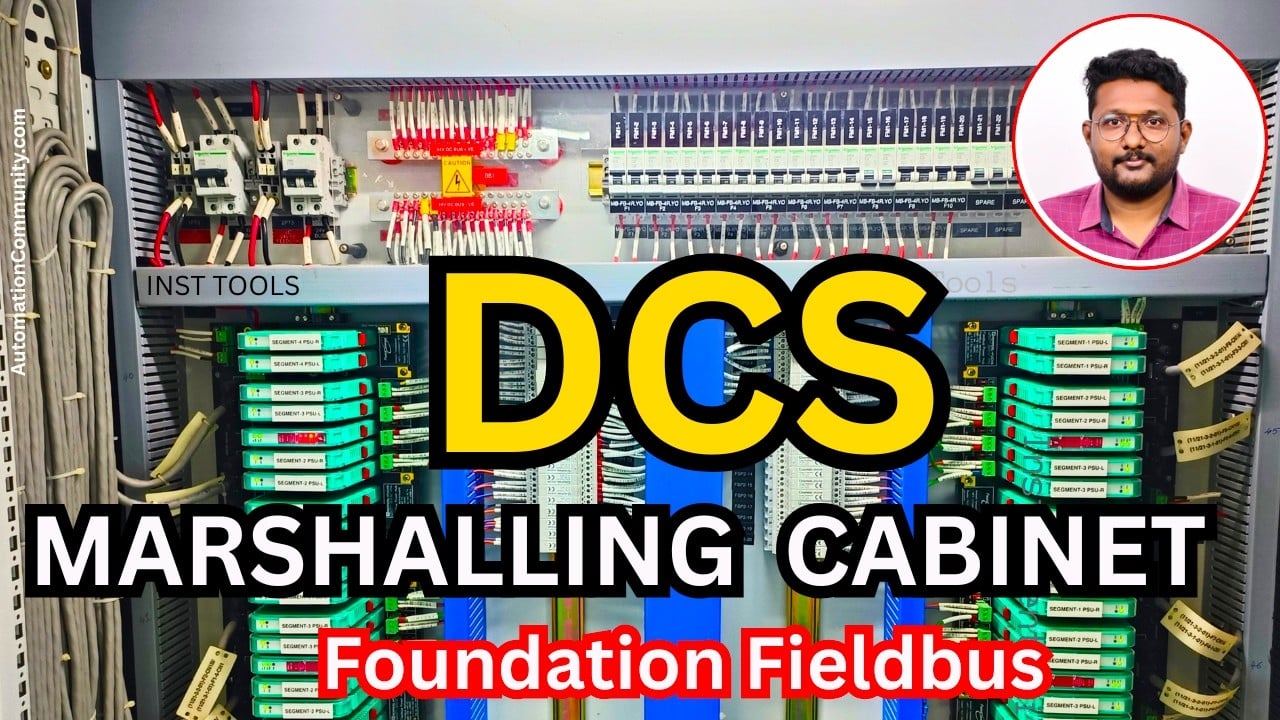
- Purpose and role of DCS marshalling cabinets
- Overview of DCS system cabinets and FF modules
- Complete system architecture from the field to the control system
About Foundation Fieldbus
Foundation Fieldbus is a digital communication protocol used in process industries to connect field instruments with control systems.
It allows two-way communication over a single network, replacing traditional 4-20 mA analog signals.
Key Characteristics
- Operates at 31.25 kbps (H1 level)
- Supports multiple devices on a single communication cable
- Uses digital signals instead of analog (4–20 mA)
- Supports control functions at the field level
- Provides deterministic (cyclic) communication
This technology is widely used in:
- Oil and gas industries
- Power plants
- Chemical and process industries
Understanding the Real System
This course explains how Foundation Fieldbus systems are implemented in actual industrial plants.
You will understand:
- Connection of the fieldbus field instruments
- Use of FF junction boxes for field wiring
- Signal routing through marshalling cabinets
- Integration with system cabinets and DCS
This will help you clearly understand how data moves from field devices to the control system.
Who This Course Is For
- Instrumentation engineers
- PLC and DCS engineers
- Beginners in industrial automation
- Maintenance engineers
- Students entering the automation field
Why This Course Is Different
- Focus on practical understanding
- Simple and structured explanation
- Covers real system architecture and wiring
- Suitable for beginners
What You Gain
After completing this course, you will:
- Understand how Foundation Fieldbus works in real systems
- Gain clarity on communication and wiring concepts
- Build a strong foundation for advanced learning
To continue your learning, you can enroll in:
👉 Foundation Fieldbus: Complete Practical Training Course, where basics, working principles, DCS programming, practical videos, and fieldbus device configuration are covered.
Final Note
Foundation Fieldbus is an important technology in modern process automation. A clear understanding of its basics will help you work more effectively in industrial systems.
This course provides a simple and practical starting point for your learning journey.
Instructor
S Bharadwaj Reddy
Course Content
Foundation Fieldbus (FF)
-
06:22
-
Foundation Fieldbus Instruments
10:49 -
Introduction to Foundation Fieldbus
04:45 -
Why Was Foundation Fieldbus Developed?
09:03 -
Foundation Fieldbus Junction Box and Cables
08:42 -
Foundation Fieldbus Architecture: Field to System
05:48 -
DCS Marshalling Cabinet Details and Function
17:49 -
DCS System Cabinet Overview and Components
10:08 -
Course Conclusion